
Introduction
AI Studio Portrait Prompt for Traditional Indian Family Look (Pattu Veshti & Saree, 4K Realistic Style) Arun had been thinking about creating a proper family portrait for a long time. Not just a casual mobile photo, but something that felt meaningful — the kind of image you would print, frame, and keep in your living room for years. The problem was that his family never had a single moment where everyone was dressed traditionally, standing together, and photographed in a controlled setting. Every photo they had felt incomplete in some way. Some had good lighting but missing members, others had everyone present but lacked the elegance he imagined. That gap is what led him to explore AI as a way to create something that never actually happened, but still felt real.
The First Attempt Feels Generic and Unfinished
He began with a simple idea and an even simpler prompt, expecting the AI to understand what he meant without much detail. He uploaded the photos and described it as a traditional family portrait with a studio background. The result came quickly, but it didn’t feel right. The image looked artificial in subtle ways. The clothing didn’t reflect any specific culture, the background felt flat, and most importantly, the faces didn’t fully resemble his family. It wasn’t a bad output, but it lacked intention. That’s when he realized that AI doesn’t fill in emotional or cultural gaps on its own — it only responds to what is clearly described.
Defining the Environment Changes the Entire Mood
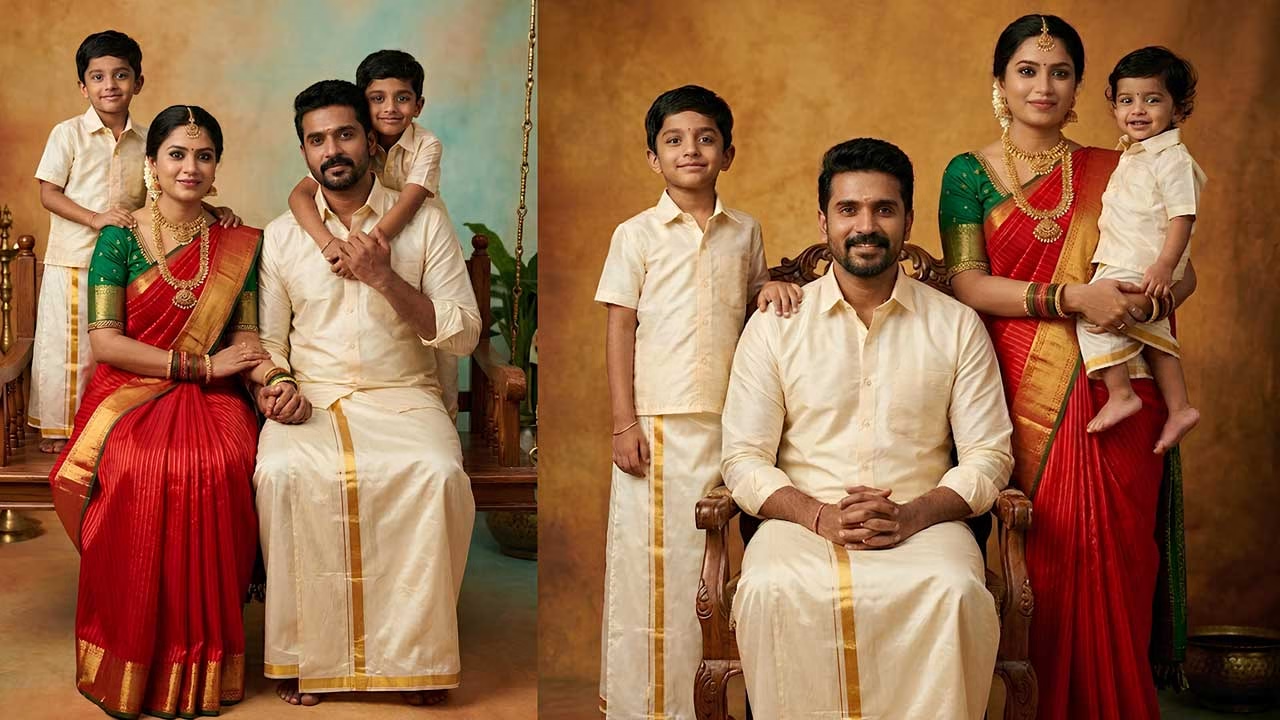
AI Studio Portrait Prompt for Traditional Indian Family Look (Pattu Veshti & Saree, 4K Realistic Style) Instead of trying to fix everything at once, Arun focused on one decision — the setting. He understood that the background would define the tone of the image more than anything else. So he rewrote that part of the prompt to include a studio background with a bold vintage gradient and a wooden swing. When he generated the image again, the difference was immediately noticeable. The scene felt more composed, almost like a professional photoshoot. The wooden swing added a familiar cultural touch, and the gradient background gave depth. It still wasn’t perfect, but it no longer felt random.
Describing Relationships Brings Life Into the Frame
Even with a better setting, something still felt missing. The family members looked like they were placed next to each other rather than connected. Arun realized that the AI needed help understanding how people in the image should interact. So he made a small but important change by describing how the family should be positioned — the couple sitting together and the children standing close, holding them with affection. This adjustment transformed the image in a subtle but powerful way. The output now carried emotion. It didn’t just show people; it showed relationships.
Cultural Details Turn a Good Image Into a Personal One
At this point, the image started to look structured, but it still didn’t feel personal to Arun’s background. The clothing was the next decision he focused on. Instead of saying “traditional wear,” he specified exactly what he wanted — a cream-colored pattu veshti sattai for the man and a red pleated saree with a green blouse and heavy jewelry for the woman. This level of detail made a significant difference. The AI stopped guessing and started following. The textures, colors, and styling suddenly aligned with what he had always imagined. The image now felt rooted in a specific culture rather than being generically “traditional.”
Preserving Facial Identity Becomes the Most Critical Step
Just when everything seemed to be coming together, Arun noticed something that bothered him more than anything else. The faces, although similar, were slightly altered. It wasn’t dramatic, but it was enough to make the image feel less authentic. He understood that no matter how good the background or clothing looked, if the faces weren’t accurate, the image would fail its purpose. So he added a strict instruction to retain the exact facial features without any modification. This wasn’t about improving the image — it was about protecting what mattered most. After this change, the results became far more reliable, and the faces finally looked like his actual family.
Refining Quality Makes the Image Feel Professional
With structure, emotion, and identity in place, Arun turned his attention to the finishing layer — quality. He wanted the image to look like it belonged in a high-end studio album, not just a digital experiment. He added terms like high detail, editorial photography style, and 4K resolution, along with a symmetrical composition and a vertical 9:16 ratio. These weren’t major structural changes, but they elevated everything. The lighting became more balanced, the textures sharper, and the overall presentation cleaner. The image now looked polished rather than generated.
The Prompt Evolves Through Decisions, Not Perfection
AI Studio Portrait Prompt for Traditional Indian Family Look (Pattu Veshti & Saree, 4K Realistic Style) What stood out to Arun after this process was that he never wrote a perfect prompt from the beginning. Each version of the prompt was a response to what the previous output lacked. When the background felt weak, he improved the setting. When the image lacked emotion, he defined relationships. When the clothing felt generic, he added cultural specificity. When the faces changed, he enforced realism. Every improvement came from noticing a problem and making a clear decision to fix it. The final prompt was not a single idea but a collection of small, purposeful adjustments.
When the Image Finally Feels Like a Memory
The final result didn’t feel like something generated by AI. It felt like a moment that had always existed but was never captured. The way the couple sat calmly on the swing, the way the children leaned in, and the balance of tradition with studio elegance all came together naturally. Arun didn’t stop because the image was technically perfect, but because it finally felt right. It carried familiarity, emotion, and identity — everything he had been trying to create from the beginning without even fully realizing it.
Testing Small Variations Reveals What Actually Matters
Even after arriving at a strong result, Arun didn’t immediately settle. Instead, he started testing small variations to understand which parts of the prompt truly influenced the outcome. He slightly adjusted the lighting description, changing it from a general studio feel to a softer, diffused light. In another version, he reduced the intensity of the vintage gradient background to see if a subtler tone would feel more natural. These weren’t random experiments — each change was intentional, aimed at isolating one element at a time. Through this process, he noticed that while background and lighting enhanced the image, the emotional positioning and facial accuracy had the strongest impact. This helped him prioritize what to keep fixed and what could be flexible in future prompts.
Learning When to Stop Editing Becomes a Key Decision
AI Studio Portrait Prompt for Traditional Indian Family Look (Pattu Veshti & Saree, 4K Realistic Style) At one point, Arun found himself continuously tweaking words, expecting even better results with every iteration. But something interesting happened — some newer outputs, despite being technically refined, started losing the natural feel he had achieved earlier. The image became too polished, almost artificial. That’s when he realized that improvement isn’t always about adding more detail. Sometimes, it’s about recognizing when the image already communicates what it needs to. He went back to a previous version of the prompt — one that balanced realism and quality without over-processing — and used that as his final version. Knowing when to stop became just as important as knowing what to change.
Conclusion
After completing this process, Arun didn’t just save the final prompt — he understood the pattern behind it. He now knew how to approach similar ideas in the future without starting from scratch. If he wanted a different setting, he could swap the environment while keeping the emotional structure intact. If he wanted a different outfit style, he could change only the clothing description without affecting composition. This shifted his mindset from “writing a prompt” to “building a system.” The real value wasn’t just the final image he created, but the clarity he gained in how each decision shapes the output.
Link Here
Inspired by viral Instagram reels, these cute family picture prompts feature vertical stacking arrangements where family members create playful hand gestures, winking expressions, and puckered lips for a humorous, heartwarming effect